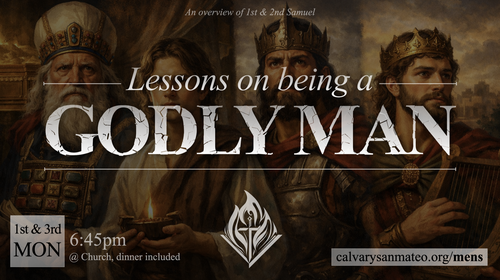
Lessons on being a

GODLY MAN

—From 1st & 2nd Samuel—

Our Calvary Men will be going through the books of 1st & 2nd Samuel highlighting the lives of men in those books and what we can learn from them—the good, the bad, and the ugly—about being a Godly man today.

Every 1st & 3rd Monday of the Month
6:46p - 8:30p
Dinner included

SESSION 1: Eli.

    Monday, April 20th

Eli was the high priest of Israel at Shiloh. He judged Israel for about 40 years. He wasn’t a villain—he knew God, served faithfully, and even mentored young Samuel. But his leadership collapsed at home. Here are his core failures and where we can learn from him:

  1. Passive Fatherhood — His sons, Hophni and Phinehas, were corrupt priests (stole offerings meant for God, slept with women serving at the tabernacle.) Eli knew—and only gave soft verbal warnings. He confronted, but never corrected — he was too passive and it destroyed him and his family.
  2. Fear of Man Over Fear of God — God’s verdict (through a prophet and later Samuel) was brutal: Eli “honored his sons above God.” He chose: family comfort, avoiding conflict, and maintaining peace over obeying God. If you won’t lead your family under God, your family will lead you away from Him.
  3. Spiritual Authority Without Personal Discipline — Eli functioned as priest but lost moral authority at home. He wore the role—but didn’t enforce the standard. You can’t outsource spiritual leadership. Your title means nothing if your house is out of order.
  4. Delayed Obedience = Disobedience — Eli didn’t act decisively when it mattered. By the time judgment came, it was irreversible: his sons died in battle, the Ark was captured, he fell backward and died when he heard the news. What you tolerate today becomes what destroys tomorrow.

Discussion Questions:

  1. Read Proverbs 30:20. Why is it dangerous for us to be led by our own desires, doing what is right in our own eyes?
  2. What are some cultural ideas and habits that God has convicted you of accepting?
  3. Read 1 Peter 3:14-17. How can and will you practice these verses in the next 2 weeks?
  4. Read James 4:17. Is there an area of your life that you sense God wants you to be more proactive?
  5. What are some ways God has given you victory over sin in your life?
  6. Read 1 Peter 2:1-2. Consider how you can be a good priestly image like Christ in the next 2 weeks.

SESSION 2: Samuel.

    Monday, May 4th

SAMUEL – A SHADOW OF CHRIST.
Emerging during a dark and desperate time in the history of God’s people, Samuel arrives as an answer to Hannah’s prayers and turns the tides of Israel’s spiritual and political depravity. Like others found in the pages of our Old Testament, the life and ministry of Samuel presents to us images of what the Lord Jesus Himself would later do. As we study the life of Samuel, we’ll see the following similarities to the life and ministry of Jesus:

  • His miraculous birth (1 Samuel 1:5 / Luke 1:34)
  • His life dedicated to the Lord (1 Samuel 1:11 / John 6:38)
  • He came as a result of prayer (1 Samuel 1:17 / Luke 2:36–37)
  • His mission was to deliver a nation (1 Samuel 7:3–17 / Luke 15:24)
  • He sets the stage for the Davidic Kingdom (1 Samuel 6:13 / Luke 1:32)

Interesting facts: Hannah is derived from the Hebrew word “Hanan” meaning grace or favor. Samuel is a Hebrew name meaning “God has heard” or “name of God,” derived from “Shemuel.” In the Bible, the name signifies a direct answer to prayer.

Samuel was a faithful man and although all of us sin there is no notable recorded sin in the Biblical record of Samuel, perhaps giving us a picture of the future life of Christ who never sinned. Samuel ministered to Israel on a circuit which took him throughout the nation. During his ministry, King Saul’s disobedience would result in Samuel walking away from him and, at the Lord’s direction, anointing David as King (1 Samuel 13:14). Failing to obey God would lead Saul into a troubled and dark time in his life and in the history of Israel.

Here's the situation during Samuel's ministry:
  • National rejection of God. Israel demanding a human King was seen as a rejection of God as their true ruler.
  • Corrupt Leadership. Samuel's sons, Joel & Abijah, whom he appointed as judges, were corrupt, taking bribes and perverting justice.
  • Desire for Conformity. Israel wanted to have a King to be like, "all the other nations," instead of being a unique nation set apart to the Lord.
  • Lack of Faith. They also wanted a King to go out before them and fight their battles, showing a lack of trust in God's ability to protect them.
  • Spiritual Disobedience. The people often fell into sin, forcing God to send judges, and struggled to remain faithful throughout this transition period.

Discussion Questions:

  1. As we review this list, what similarities do you see to our nation today? (See: Matthew 24:12, 2 Timothy 3:1–5)
  2. What about the church? Are there any similarities to the church in America? (See: 2 Corinthians 12:21, Revelation 3:14–20)
  3. How do we guard ourselves from falling into these evils? (See: Psalm 119:9, Galatians 5:15–16, Hebrews 10:25)
  4. How’s your walk? Share in confidence with your table which of these areas you struggle with. (See: Proverbs 28:30, James 5:16)
  5. Let’s apply what we’ve learned. What does modeling Samuel’s life and his ministry look like to you? (See: 2 Corinthians 3:18, Ephesians 4:11–13)

SESSION 3: King Saul.

    Monday, May 18th

King Saul started well: humble, strong, anointed, and decisive. Yet his meteoric rise was ultimately matched by a devastating downward spiral that ended in tragedy—taking his own life as the enemy closed in around him. He indeed “played the fool and erred exceedingly.” (1 Samuel 26:21)

Still, we should be thankful that Saul’s life was recorded honestly in God’s Word (Romans 15:4), because we can learn from his failures without having to repeat them ourselves. Men can often see themselves in Saul’s weaknesses: the fear of man, jealousy, pride, insecurity, and the instability that follows when everything begins collapsing around them.

Saul carried enormous responsibility. He started well, but he did not finish well. And that’s one of the great lessons of his life: anyone can start strong, but what matters most is how you finish—and the legacy you leave behind.

An overview of Saul's life:
  • 1 Samuel 9 — Saul is introduced while searching for his father’s donkeys and is providentially led to Samuel.
  • 1 Samuel 10 — Samuel anoints Saul king, God gives him another heart, and Saul is publicly chosen before Israel.
  • 1 Samuel 11 — Saul rises courageously to deliver Jabesh Gilead and is confirmed as king by the people.
  • 1 Samuel 12 — Samuel gives a farewell warning, urging Saul and Israel to fear and obey the Lord.
  • 1 Samuel 13 — Saul unlawfully offers sacrifice out of fear and impatience, leading Samuel to announce that his kingdom will not endure.
  • 1 Samuel 14 — Jonathan wins a great victory while Saul makes a rash oath that nearly costs Jonathan his life.
  • 1 Samuel 15 — Saul disobeys God by sparing Agag and the Amalekite spoil, causing God to reject him as king.
  • 1 Samuel 16 — The Spirit departs from Saul, David is anointed, and Saul is troubled by an evil spirit.
  • 1 Samuel 17 — Saul faces Goliath in fear while David steps forward in faith to defeat the giant.
  • 1 Samuel 18 — Saul becomes intensely jealous of David after his military success and begins seeking to kill him.
  • 1 Samuel 19 — Saul repeatedly attempts to murder David, even sending men to hunt him down.
  • 1 Samuel 20 — Saul’s rage erupts against Jonathan for defending David, confirming his murderous intent.
  • 1 Samuel 21 — David flees from Saul and begins living as a fugitive.
  • 1 Samuel 22 — Saul orders the slaughter of the priests at Nob because they helped David.
  • 1 Samuel 23 — Saul relentlessly pursues David through the wilderness, but God continually preserves David.
  • 1 Samuel 24 — David spares Saul’s life in a cave, and Saul temporarily admits his own wrongdoing.
  • 1 Samuel 25 — Saul remains in pursuit of David while David encounters Abigail and Nabal.
  • 1 Samuel 26 — David again spares Saul’s life, exposing Saul’s spiritual instability and obsession.
  • 1 Samuel 27 — Saul’s pursuit drives David to seek refuge among the Philistines.
  • 1 Samuel 28 — In desperation and spiritual darkness, Saul consults the medium of Endor before battle.
  • 1 Samuel 29 — The Philistines reject David from joining their battle against Saul.
  • 1 Samuel 30 — While David rescues Ziklag, Saul prepares for his final confrontation with the Philistines.
  • 1 Samuel 31 — Saul is defeated on Mount Gilboa and dies by falling on his own sword as Israel collapses before the Philistines.


Discussion Questions:

  1. Saul started with humility, gifting, and the Spirit of God upon him — but slowly drifted through fear, pride, and partial obedience. Looking at your own life, where are you most tempted to compromise: fear of people, desire for control, protecting your image, jealousy, impatience, or something else? (Read Proverbs 4:25-27 & Hebrew 12:1-2)
  1. One of Saul’s biggest problems was that he cared more about outward appearance and public opinion than inward obedience to God — basically the “fear of man.” How is it so easy to have a fear of man and yet not a more overwhelming fear of God? (Read Proverbs 29:25)
  1. Saul became consumed with jealousy toward David because David threatened Saul’s position, identity, and recognition. Why do you think comparison and jealousy are so destructive among men? What are practical ways we can fight that temptation? (Read Proverbs 27:4)
  1. Saul repeatedly defended and justified himself instead of humbling himself in repentance. David sinned too, but David repented deeply when confronted. Why is genuine repentance so difficult for men sometimes? What usually keeps us from admitting we’re wrong? (Read Proverbs 28:13)
  1. One of the mercies of God is that we do not have to personally destroy our lives to learn wisdom. God gave us His Word, and men like Saul, so we can see where certain paths lead before we walk them ourselves. Looking at Saul’s life, what warnings or tendencies do you see that could also exist in your own heart if left unchecked? How can failure — both our own and the failures recorded in Scripture — become a teacher that drives us closer to God instead of farther from Him? (Read Proverbs 4:23)

SESSION 4: King David.

    Monday, June 1st

Notes coming soon.

Discussion Questions:

Coming soon.