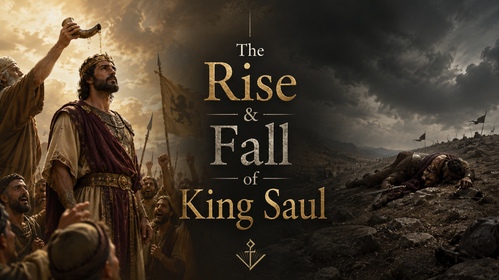
King Saul started well: humble, strong, anointed, and decisive. Yet his meteoric rise was ultimately matched by a devastating downward spiral that ended in tragedy—taking his own life as the enemy closed in around him. He indeed “played the fool and erred exceedingly.” (1 Samuel 26:21)
Still, we should be thankful that Saul’s life was recorded honestly in God’s Word (Romans 15:4), because we can learn from his failures without having to repeat them ourselves. Men can often see themselves in Saul’s weaknesses: the fear of man, jealousy, pride, insecurity, and the instability that follows when everything begins collapsing around them.
Saul carried enormous responsibility. He started well, but he did not finish well. And that’s one of the great lessons of his life: anyone can start strong, but what matters most is how you finish—and the legacy you leave behind.
An overview of Saul's life:
- 1 Samuel 9 — Saul is introduced while searching for his father’s donkeys and is providentially led to Samuel.
- 1 Samuel 10 — Samuel anoints Saul king, God gives him another heart, and Saul is publicly chosen before Israel.
- 1 Samuel 11 — Saul rises courageously to deliver Jabesh Gilead and is confirmed as king by the people.
- 1 Samuel 12 — Samuel gives a farewell warning, urging Saul and Israel to fear and obey the Lord.
- 1 Samuel 13 — Saul unlawfully offers sacrifice out of fear and impatience, leading Samuel to announce that his kingdom will not endure.
- 1 Samuel 14 — Jonathan wins a great victory while Saul makes a rash oath that nearly costs Jonathan his life.
- 1 Samuel 15 — Saul disobeys God by sparing Agag and the Amalekite spoil, causing God to reject him as king.
- 1 Samuel 16 — The Spirit departs from Saul, David is anointed, and Saul is troubled by an evil spirit.
- 1 Samuel 17 — Saul faces Goliath in fear while David steps forward in faith to defeat the giant.
- 1 Samuel 18 — Saul becomes intensely jealous of David after his military success and begins seeking to kill him.
- 1 Samuel 19 — Saul repeatedly attempts to murder David, even sending men to hunt him down.
- 1 Samuel 20 — Saul’s rage erupts against Jonathan for defending David, confirming his murderous intent.
- 1 Samuel 21 — David flees from Saul and begins living as a fugitive.
- 1 Samuel 22 — Saul orders the slaughter of the priests at Nob because they helped David.
- 1 Samuel 23 — Saul relentlessly pursues David through the wilderness, but God continually preserves David.
- 1 Samuel 24 — David spares Saul’s life in a cave, and Saul temporarily admits his own wrongdoing.
- 1 Samuel 25 — Saul remains in pursuit of David while David encounters Abigail and Nabal.
- 1 Samuel 26 — David again spares Saul’s life, exposing Saul’s spiritual instability and obsession.
- 1 Samuel 27 — Saul’s pursuit drives David to seek refuge among the Philistines.
- 1 Samuel 28 — In desperation and spiritual darkness, Saul consults the medium of Endor before battle.
- 1 Samuel 29 — The Philistines reject David from joining their battle against Saul.
- 1 Samuel 30 — While David rescues Ziklag, Saul prepares for his final confrontation with the Philistines.
- 1 Samuel 31 — Saul is defeated on Mount Gilboa and dies by falling on his own sword as Israel collapses before the Philistines.